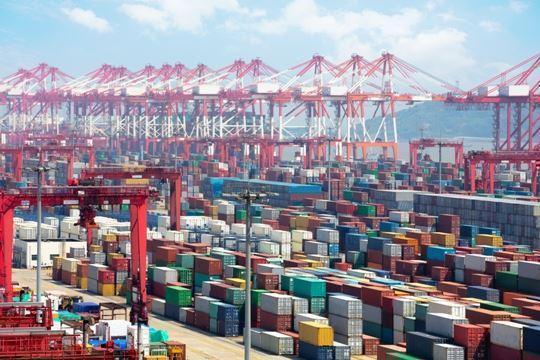
Shanghai Port is a port of Shanghai, China, located in the middle of the Chinese mainland coastline and the Yangtze Estuary. It passes through the northern and southern coastal regions of China and the world ocean and runs through the Yangtze River Valley and the inland rivers and Taihu basins of Jiangsu, Zhejiang and Anhui provinces.
Location context
Shanghai port is located at the Chinese mainland coastline center and the Yangtze River’s throat. It is the intersection point of China from west to East, with the Yangtze River as the horizontal axis and from north to South with the coastline as the longitudinal axis. The geographical coordinates are 31 ° 14 ’n and 121 ° 19’E. Shanghai port area consists of 66.6 kilometers of Huangpu River and 106.5 kilometers of the South Bank of the South waterway of the Yangtze River Estuary. The land area of Shanghai port area consists of the south bank port area of the Yangtze River Estuary, the north bank port area of Hangzhou Bay, Huangpu River port area and Yangshan deep-water port area.
The indirect economic hinterland of Shanghai Port mainly includes southern Zhejiang, Northern Jiangsu, Anhui, Jiangxi, Hubei, Hunan, Sichuan and other provinces. Port materials flow to Hinterland: including Zhejiang, Jiangsu, Anhui, Jiangxi, Hubei, Hunan, Sichuan, Fujian, Henan, Shaanxi, Qinghai, Gansu, Ningxia and Xinjiang.
Climatic conditions
Shanghai port is in a subtropical marine monsoon climate. Affected by the alternation of winter and summer monsoon, the four seasons change clearly. It’s warm and rainy all year round. The annual average temperature is about 16 ℃, and the annual precipitation is about 1148.8 mm.
The wind condition in Shanghai port is most southeast wind, followed by west wind and northeast wind, and the strong wind is northeast wind. From 1884 to 1981, there were 55 typhoons (with wind force greater than or equal to 10) with serious impact. The duration of the typhoon was up to 3 days, and the maximum wind speed was 43.9 M / s. The annual average foggy day in Shanghai port is 25.5 days, which generally dissipates before 10 a.m. and the heavy fog that does not dissipate all day is rare.
Route
In 2004, Shanghai port opened 33 new international container liner routes throughout the year, including 21 ocean liner routes in Europe, North America, the Middle East and Australia, reaching 12 major shipping areas in the world and establishing business contacts with more than 500 ports in nearly 200 countries and regions. By the end of 2016, Shanghai port had established container cargo trade with more than 500 ports in 214 countries and regions around the world, with more than 80 international routes.
Short comments: The phase IV wharf of Yangshan port area of Shanghai port is an important symbol of China's economic integration into the global economy. It will further promote the liberalization and facilitation of China's trade and investment.
 General Concept Of Mechanical SealJuly 4, 2022Mechanical seal refers to at least a pair of end faces perpendicular to the axis of rotation under the action of fluid pressure and the elastic force of the compensation mechanism (or magnetic force) ...viewIndustrial Coating VOCs Emissions? How To Use Waterborne Coating To Reduce Emissions in Steel Barrel ManufacturingJuly 1, 2022In recent years, the rapid development of China's national economy has attracted worldwide attention, but the consequent environmental pollution and resource shortage have become increasingly appa...view
 The Prospect Of Industrial Waterborne Coating Is Bright!June 30, 2022In recent years, profound changes have taken place in the understanding and imagination of coatings in China, and the output of environmentally friendly coatings has increased year by year. From tradi...view
 A Sudden! Nearly 40 Barrels Of Chemicals Have Leaked! The Main Person in Charge Is Under Police Control!July 1, 2022According to the emergency management bureau of Wuhan Jiangan District, a chemical leak occurred at around 5 o 'clock on August 29 in room 807 of Kaixin Building, a commercial and residential buil...viewThe Function of Galvanized Bucket PlugJune 5, 2023Steel drums are commonly used containers for storing and transporting liquid chemicals. However, electrochemical reactions can occur between the liquid and the steel plate, causing corrosion, damage, ...viewPerformance Characteristics of the Steel DrumOctober 25, 2023The application of steel drums has only a history of just over one hundred years, but it has developed rapidly and has a wide variety of types. It is widely used in industrial product packaging, trans...view
 EN
EN
 ko
ko  fr
fr  de
de  es
es  it
it  ru
ru  pt
pt  ar
ar  vi
vi  th
th